
Ambiguous Gestalt 🟡 Medium
Penrose Triangle
A beautiful, mathematically impossible geometric structure that loops forever.
Use the controllers inside the display card to interact with the visual triggers.
🎮 EXPERIENCE IT FIRST
Before reading the neuroscience explanation below, take a moment to interact with the demo above:
- How does the visual change when you move your eyes or look at different parts of the screen?
- Use the slider or toggle buttons to reveal the actual geometric layout. Did it match what your eyes predicted?
- Pay attention to whether you can consciously force your brain to switch between interpretations.
🧠 THE SCIENCE
The Penrose Triangle (or impossible tribar) is a classic bistable geometrical illusion representing an impossible object. The drawing consists of three straight bars of square cross-section, which meet pairwise at right angles to form a triangle.
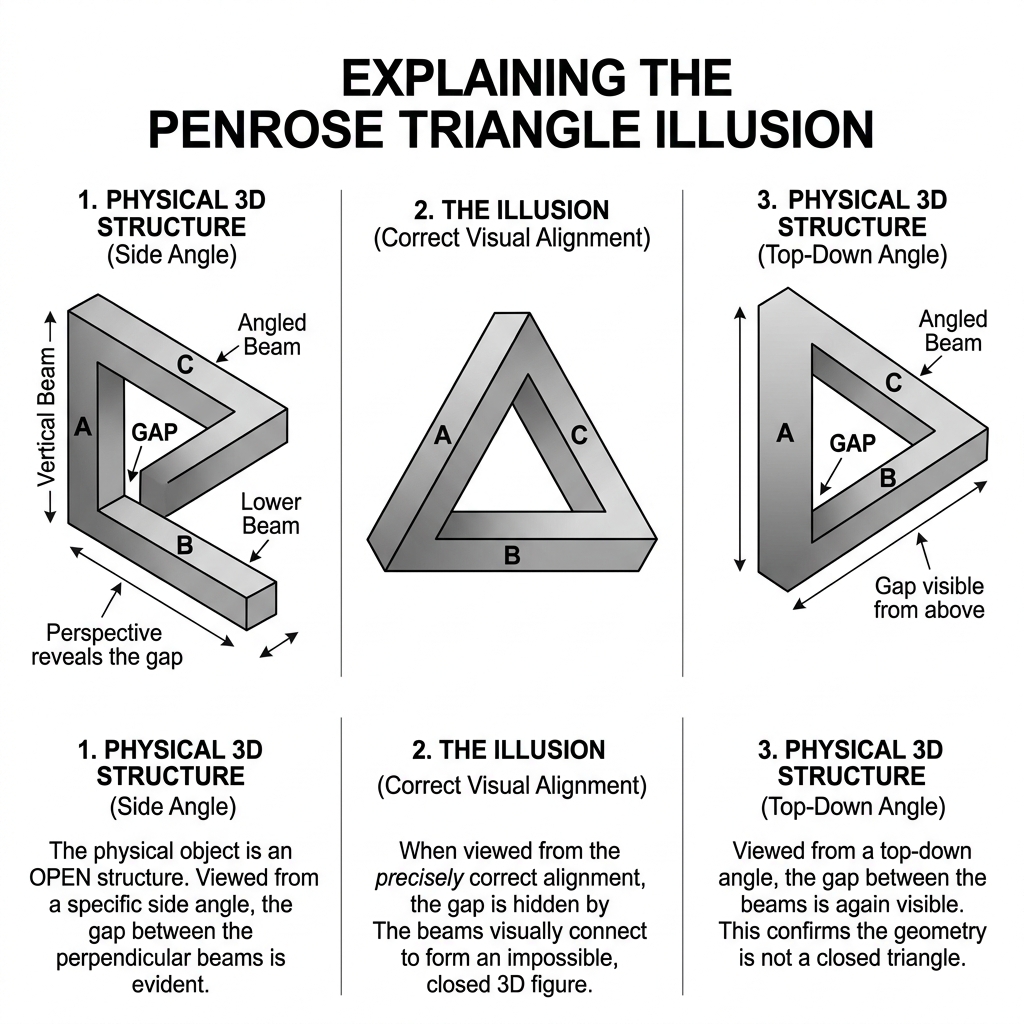 Figure: The Penrose Triangle viewed from different physical angles, showing how the illusion relies on alignment.
 This object cannot exist in 3D space. However, because our visual cortex processes 3D depth from 2D coordinates locally, it assumes that each corner is a valid, normal right angle. The brain connects these local corner hypotheses sequentially. Only when the visual system tries to integrate the entire structure globally does it realize the depth coordinates are conflicting. This triggers a perpetual loop of spatial re-evaluation in the parietal lobe, as the brain cannot find a single, consistent 3D model.
💡 FUN FACTS
- • First drawn by Swedish artist Oscar Reutersvärd in 1934, and independently popularized by Lionel and Roger Penrose in 1958.
- • Roger Penrose was inspired by the works of artist M.C. Escher, who later used the impossible triangle in his famous lithograph "Waterfall."
- • The illusion is only possible from a single, specific viewing angle; from any other viewpoint, it is revealed as a broken shape.
- • It illustrates that our brain constructs 3D space by linking local depth segments rather than calculating a global coordinate map.
🧪 TRY THIS AT HOME
Construct a Penrose Triangle out of cardboard. Cut one of the legs so it is split but lines up perfectly when viewed from a specific angle. Close one eye and look at it to see the impossible shape merge, then rotate it to reveal the gap!
📜 WHO DISCOVERED IT
Discoverer: Oscar Reutersvärd & Roger Penrose (1934)
Oscar Reutersvärd drew the first impossible triangle using a series of shaded cubes. In 1958, Roger Penrose (mathematical physicist) and his father Lionel Penrose popularized it as a simple perspective drawing, sharing it with M.C. Escher who turned it into iconic architectural art.
Educational Resources & History
Penrose Triangle impossible object optical illusion explanation. Discover Oscar Reutersvärd and Roger Penrose's 1958 math model, local-to-global depth conflicts in V1/parietal lobe, and M.C. Escher's waterfall designs.